Register
Sign in with your wallet, add your name and choose borrower or lender. One signature, no password.
Selfpay lends to small energy businesses against the power their unit earns. Register your meter, see exactly how much you can borrow, and every payment your customers make repays the loan. Lenders fund one shared pool on Base, Arbitrum or Tempo.
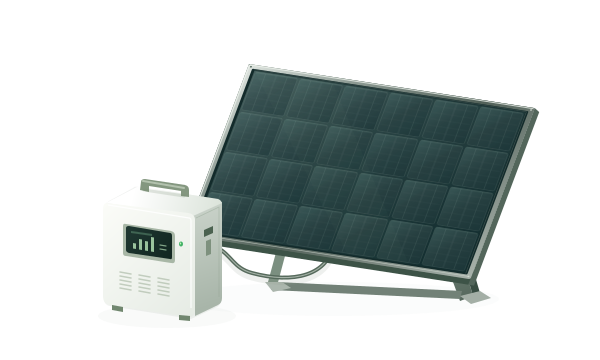
No bank statements and no guarantors. Your unit's own earnings are the proof.
Sign in with your wallet, add your name and choose borrower or lender. One signature, no password.
Enter your meter number. Your meter starts reporting how much power your unit sells every day.
We score your uptime and consistency, then show what you can borrow for 14, 28, 56 or 84 days.
Pick chain and token, confirm, done. Each customer payment repays the lender first. Miss payments and the unit locks.
Lenders deposit on Base, Arbitrum or Tempo, in USDC, USDT or USD. It all lands in a single pool, so borrowers can be funded from the whole thing.
Live from the pool, by deposit chain.
Lenders in, borrowers out. Repayments and fees flow back to the pool, so each lender's share grows.
Move the slider. These are the same formulas the app uses.
Assumptions, not promises. Fees are only earned on money that is lent out, and some loans may default.
No. Selfpay runs on test networks with test funds, so nobody can lose or earn real money. The smart contracts are deployed on Base Sepolia, Arbitrum Sepolia and Tempo Moderato, and the live monitor shows them. Meter readings are test data until real meter hardware is connected, which is on our roadmap.
We look at the last 28 days of your meter. Uptime counts for 45%, how steady your income is counts for 35%, and how much history you have counts for 20%. That gives a reliability score and a limit: half of what your unit is expected to earn over the term, less the fee.
If a weekly instalment is more than two days late, the unit locks and all revenue goes to the lender until you catch up. Pay what is late and the lock lifts. A loan that stays unpaid for 30 days is written off by the pool.
A flat 3% fee on a 28-day loan, about 39% a year, scaled to the number of days. Shorter loans cost less. There are no other charges.
Yes, in the real world they could. If loans default faster than fees come in, the pool loses value. That is why the lender page shows cautious, expected and strong outcomes before you deposit. Funds are locked for the period you choose.
So you can watch a whole loan in one sitting, the demo runs on a fast clock: one demo day passes every real minute. A 28-day loan finishes in about 28 minutes.
It takes one wallet signature and a meter number. Everything runs on test networks.